


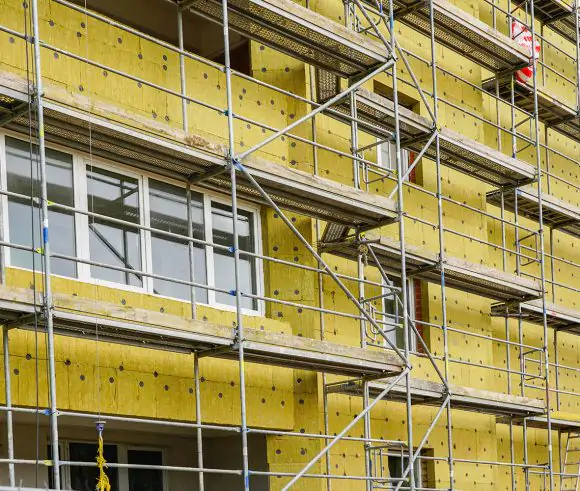

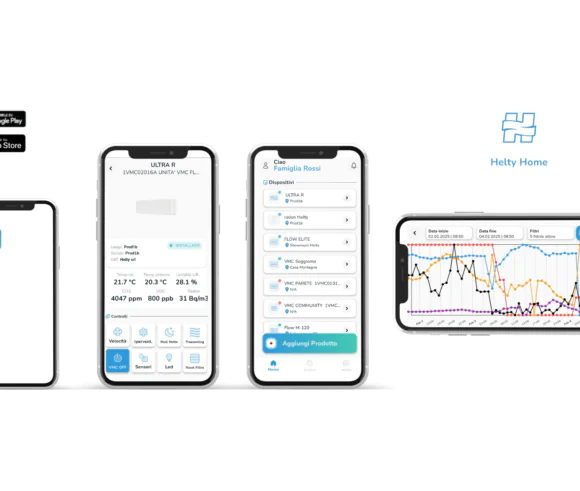



Radon gas can enter a building from the ground, mainly by rising through cracks, service penetrations and cavities. In some cases, building materials may also release radon, although generally to a lesser extent than radon originating from the soil. Ventilating indoor spaces is essential to help reduce indoor radon concentrations.
Helty heat recovery ventilation solutions
Helty means innovative decentralised mechanical ventilation solutions with air filtration and heat recovery. Our wide range of easy-to-install products make it simple to design and integrate continuous air exchange and room-to-room purification. For healthier, more comfortable and energy-efficient buildings
Discover our Range
Helty: healthy breathing in every room
Do you have a project and want to receive a tailor-made proposal?
Get a quote
FlowPLUS wins the Red Dot Design Award 2026
Helty’s decentralised MVHR system FlowPLUS has won the “Red Dot Award: Product Design 2026”, one of the world’s most prestigious international awards for product design. FlowPLUS was recognised for its ability to combine advanced technology, efficiency and design, blending into residential interiors with a discreet yet distinctive presence. This achievement confirms Helty’s commitment to developing increasingly high-performance MVHR systems that are both functional and harmonious with the spaces of the home.
Find out more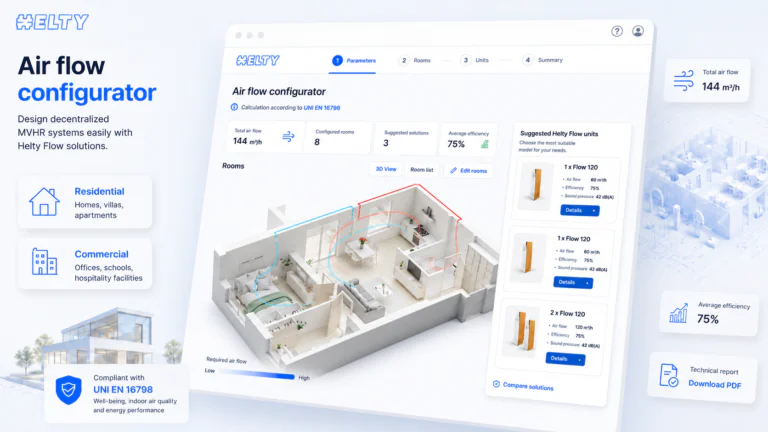
Air flow rate calculation configurator
Discover the new digital tool designed to simplify and speed up the sizing of decentralized Mechanical Ventilation with Heat Recovery systems. Developed in line with UNI EN 16798, the configurator guides professionals in defining the project’s ventilation air flow rates for both residential and commercial applications.
Find out more
Discover Flow40 with the 3D Configurator
Would you like to learn more about the concealed Helty Flow40 MVHR system and understand how it can be integrated into your project? Explore the new 3D configurator dedicated to Flow40: an interactive experience that offers a virtual tour of the solution, with specific insights into the installation, use, and maintenance of the MVHR system. *For the best experience, we recommend browsing from a desktop device.
Find out moreLearn more with the free guides!
Ai Studio analyses Helty’s decentralised Heat Recovery Ventilation system from a technical and economic point of view then compares the results with the two main alternative types of MVHRs on the market: central ventilation and autonomous channelled ventilation.
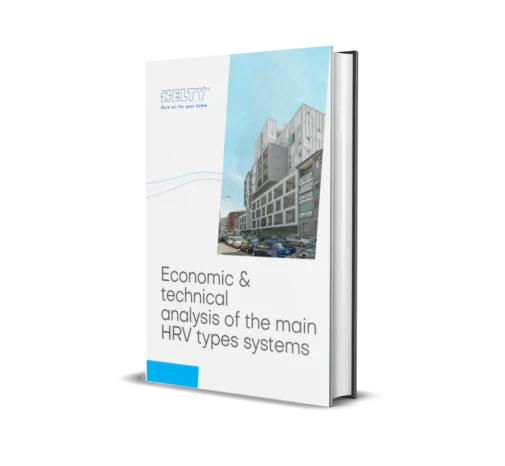
Download the Economic & technical analysis of the main MVHR types systems
Case study
Frequently asked questions
Measuring radon gas at home is a fundamental step in protecting indoor health, especially in areas at risk. This can be done using passive measuring devices, which assess radon concentrations over a longer period, or active devices, such as the Helty Radon Monitor, an innovative instrument designed for use with MVHR systems and capable of providing real-time readings.
Decentralised MVHR systems are the ideal solution for minor renovation projects or work carried out in existing buildings, as they do not require air ducting, suspended ceilings or dedicated service spaces.
The packaging contains all the main components required to install and commission the Helty MVHR unit. Tools and materials needed to drill the two 80 or 100 mm wall openings are not included.
Managing thermal bridges with insulation systems helps eliminate cold spots and heat loss, but it can also make buildings increasingly airtight, compromising ventilation in indoor spaces. Introducing MVHR with heat recovery ensures correct air renewal in thermally insulated buildings without undermining investments in energy efficiency.
A continuous dual-flow MVHR system with heat recovery helps reduce energy waste and improve comfort throughout the year. The heat exchanger preheats incoming air in winter and helps cool it in summer by using the properties of the outgoing air to transfer both sensible heat – temperature – and latent heat – humidity.
Certified quality and performance
The performance of the Helty ventilation systems are recognized by the Casa Clima Quality Seal and have obtained the SIMA and BioSafe validations

Associations and partnerships